Help them
work it out.
Then see what stays.

A difficult problem can be the beginning of a good conversation. トイ helps children work through it, find the idea worth keeping, and meet that idea again later.

Japanese tutoring · Native iPad app · Multiagent backend

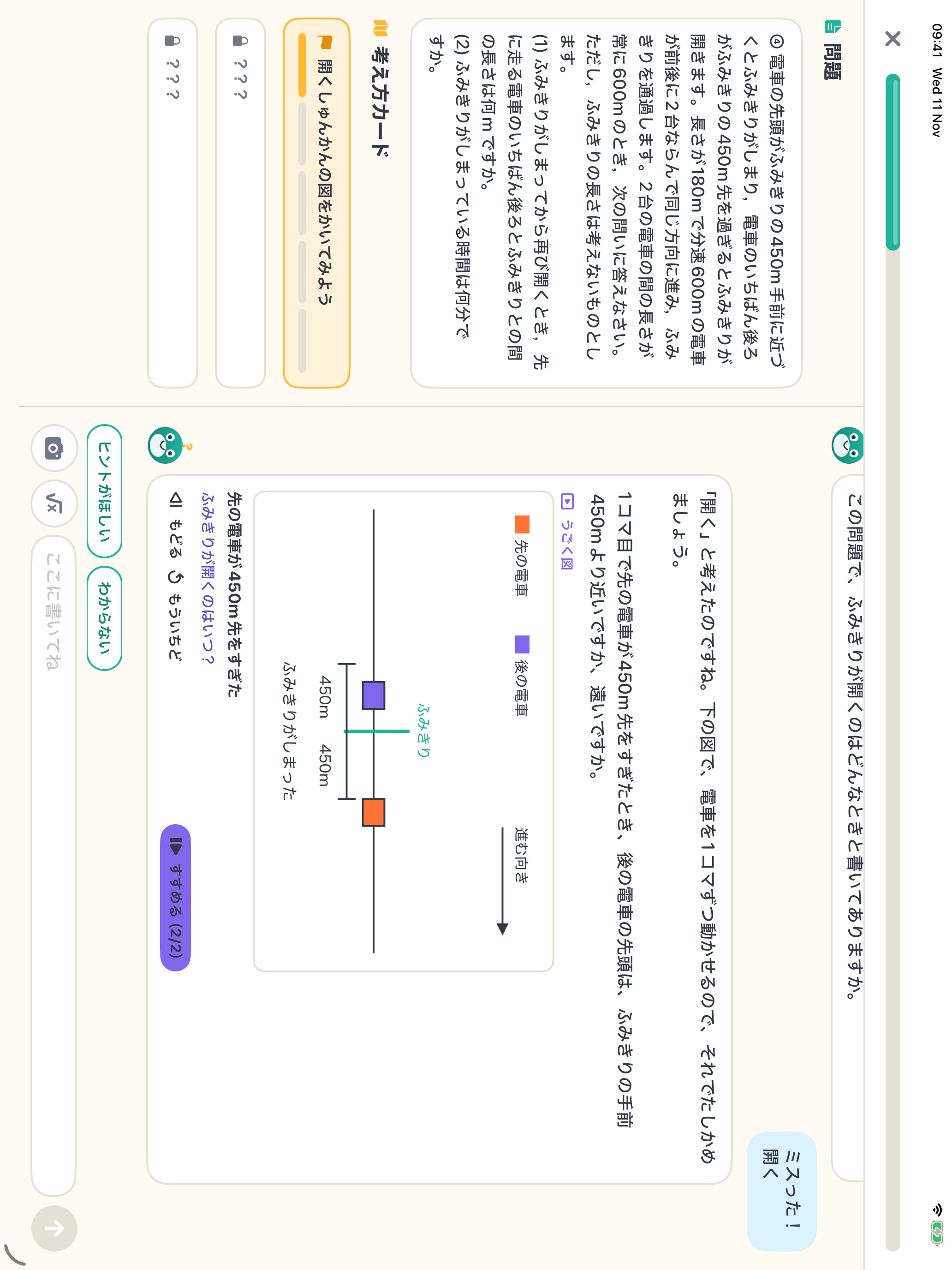
The actual Toi iPad app showing a train problem beside the tutoring conversation and a diagram with advance, replay and back controls.
The actual iPad app. A real conversation. Enlarge screenshot ↗

Photo, PDF, or typed problemRoom to draw and explainA fresh problem later

The important moment comes after the help.

Finishing a problem together is useful. The question is whether the child can recognise the same idea and use it independently on a different problem, days later.

That goal shapes the whole loop: the child produces the reasoning; the tutor gives enough support to keep moving; the lesson is put into words; a fresh problem returns later with less help.

The problem and the thinking,
side by side.

The question stays in view while the child talks, draws, and asks for help. A question of their own can start a different kind of conversation.

Fresh captures of the current app in the iOS simulator, displaying anonymized archived sessions. Names are replaced and source photos are omitted; the conversations and generated diagrams are from the records.

What the conversations actually look like

A few moments from actual sessions: getting stuck, changing an idea, and returning to it. English translations are paired with the Japanese originals. Names are removed; omissions are marked.

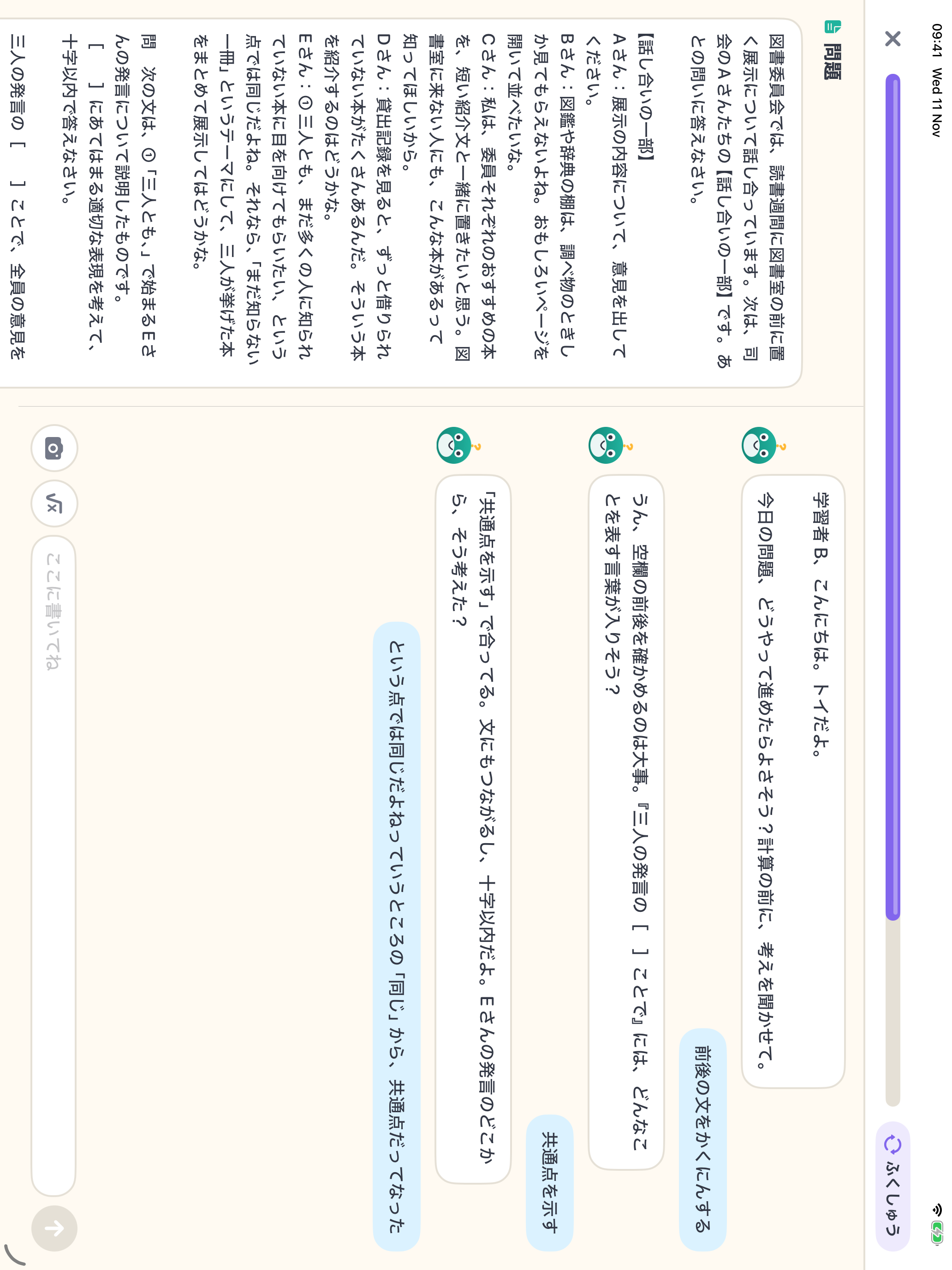
Reading: a hint, a strategy, and a review ten days later

A reading question asks what a speaker is doing when they bring several people’s ideas together. The child understands the passage but is stuck finding the wording for a short answer.

01

FIRST SESSION · THREE CONSECUTIVE MESSAGES

Child

That's the part I don't know.

トイ · opening sentence omitted

The clue is “the same” in B’s phrase “the same in that respect.” What is one term for the “same part” of two people’s ideas?

Child

What they have in common.

A hint tied to the obstacle

The tutor directs attention to a phrase in the passage. The child supplies the term. It is help with expressing an idea they have already understood.

02

LATER IN THE SAME SESSION · INTERVENING TURNS OMITTED

Child · after refining the takeaway with the tutor

Look for what the remarks before the underlined part have in common.

Keep a way of reading

The saved lesson describes where to look and what to look for. It can be used beyond the wording of this particular passage.

03

TEN DAYS LATER · A NEW PASSAGE · THREE CONSECUTIVE MESSAGES

Child · answering the review question

Pointing out what they have in common.

トイ

“Pointing out what they have in common” is correct. It fits the sentence and is within ten characters. What part of E’s remark led you to that?

Child

The word “same” in “the same in that respect” made me think of what they had in common.

Look for reasoning on the return visit

The review is linked to the same saved strategy. The child supplies the answer and identifies the textual clue. This is a closely related problem with the same cue word and answer pattern; it does not establish broad transfer.

Read the Japanese excerpts
子ども · first session
それがわかんない
トイ · opening sentence omitted
手がかりは、Bさんの「〜という点では同じ」の「同じ」。二人の考えの「同じところ」を、熟語を使ってひとことで言うと、何て言う?
子ども
共通点
子ども · later takeaway; intervening turns omitted
ー線部の前の発言の共通点を探す
子ども · review ten days later
共通点を示す
トイ
「共通点を示す」で合ってる。文にもつながるし、十字以内だよ。Eさんの発言のどこから、そう考えた?
子ども
という点では同じだよねっていうところの「同じ」から、共通点だってなった
Maths: when another question is not enough

The child is counting when clock hands overlap, starting at 2 a.m. They have guessed that the ninth overlap falls in the eleven-o’clock hour.

トイ

Let’s look at the counting again. The two-o’clock hour is the first time, and the three-o’clock hour is the second. During which hour is the ninth time?

Child

I don't get it.

トイ

I’ll explain this step. Count the two-o’clock hour as the first time, and add one each time you move to the next hour. So the four-o’clock hour is the third time. Keep counting like that up to the ninth.

Child

Oh, it was during the ten-o’clock hour! Thanks!

Explain a step, then hand the work back

Four consecutive messages show the tutor moving from a question to a concrete example of how to count. The child completes that step; calculating the exact time comes later.

Read the Japanese excerpts
トイ
数え方をもう一度見てみましょう。2時台が1回目、3時台が2回目です。9回目は何時台ですか。
子ども
わからん
トイ
この一歩は教えるね。2時台を1回目として、次の時台へ進むたびに回数を1ふやします。だから4時台は3回目です。同じように、9回目まで数えてみてください。
子ども
10時台だった!
ありがと!
Science: a correct choice can hide a mistaken belief

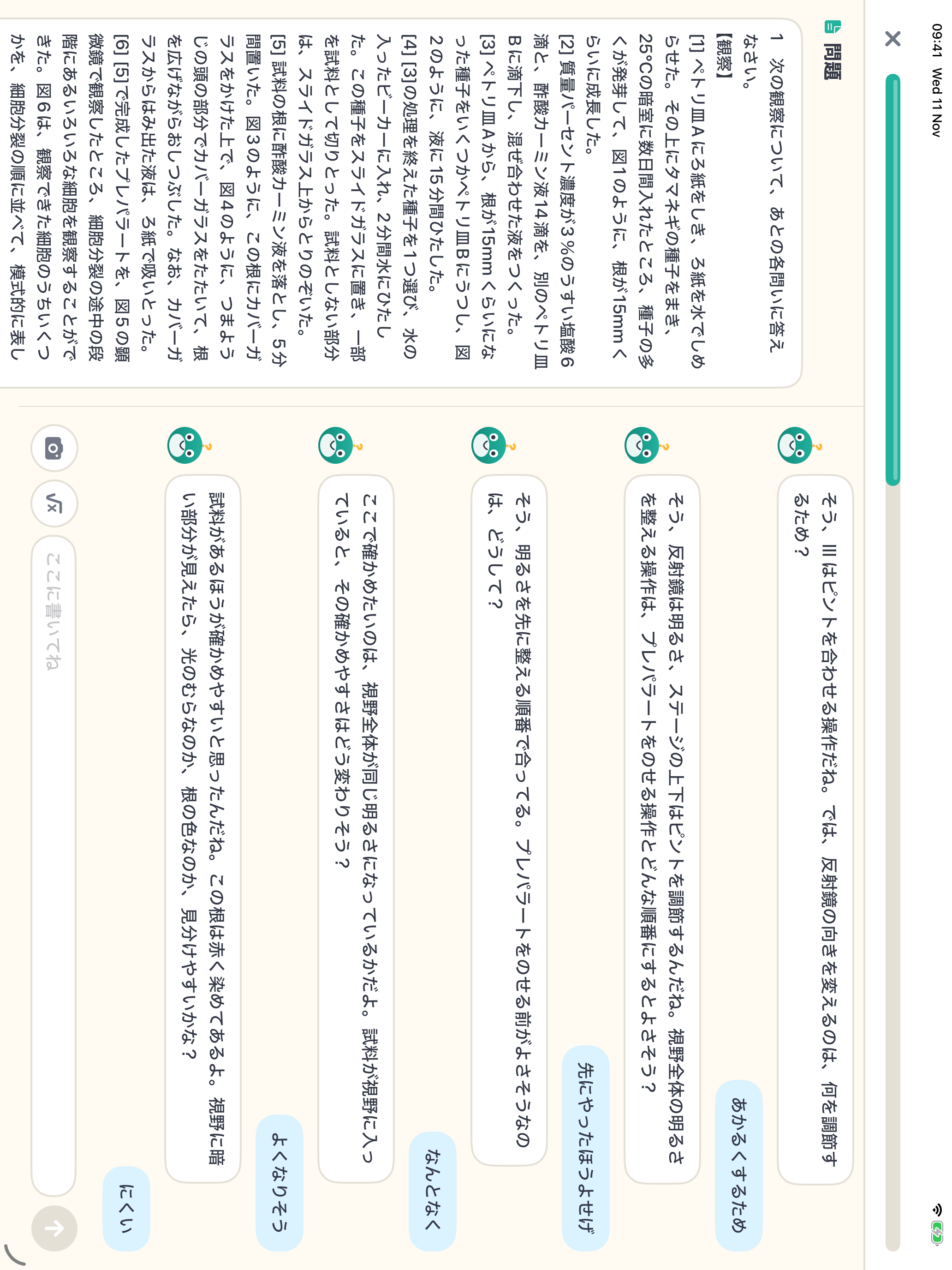
While correcting a microscope question, the child has said that brightness should be adjusted before adding the slide. Asked why, they say it was just a feeling. The tutor checks the reasoning.

トイ

What we want to check here is whether the whole field of view is equally bright. If the specimen is in view, how would that change how easy it is to check?

Child

It seems like it would be easier.

トイ

You thought it would be easier with the specimen there. This root is stained red. If you saw a dark patch, would it be easy to tell whether it was uneven light or the root’s colour?

Child

Hard to tell.

Later, after further explanation and the corrected answer · intervening turns omitted

トイ

Yes, the stained root’s colour gets in the way. At first you thought the specimen would make it easier to check. What do you think now?

Child

The opposite.

Examine why the answer makes sense

The child’s first correct choice did not reveal their belief about the specimen. A question tied to the actual experimental conditions made that belief visible and gave them a reason to reconsider it.

The actual iPad science conversation showing the child reconsidering whether a specimen makes it easier to check the light.

The same exchange, in the current app. Tap to enlarge.
Read the Japanese excerpts
トイ
ここで確かめたいのは、視野全体が同じ明るさになっているかだよ。試料が視野に入っていると、その確かめやすさはどう変わりそう?
子ども
よくなりそう
トイ
試料があるほうが確かめやすいと思ったんだね。この根は赤く染めてあるよ。視野に暗い部分が見えたら、光のむらなのか、根の色なのか、見分けやすいかな?
子ども
にくい
トイ · intervening turns omitted
そう、染めた根の色がじゃまになるね。最初は「試料があるほうが確かめやすそう」と思っていたけど、今はどう考えてる?
子ども
ぎゃく
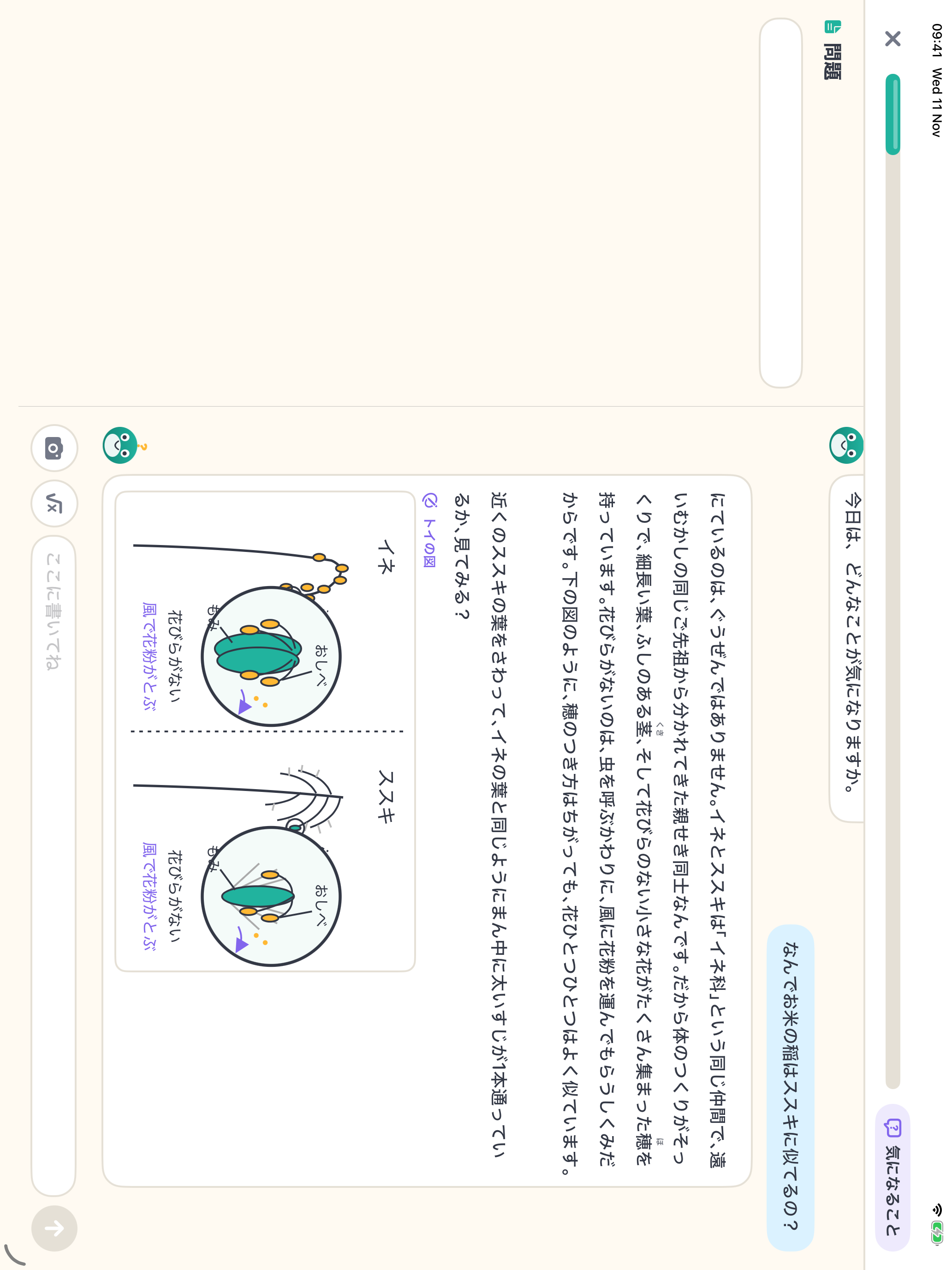
Curiosity: “Why does rice look like silver grass?”

This is a question the child brings to the curiosity conversation, without a worksheet.

Child

Why does the rice plant look like silver grass?

トイ · first two sentences

The resemblance isn’t a coincidence. Rice and silver grass belong to the same grass family; they are relatives that branched off from the same ancestor long ago.

Further explanation, a drawing and the child’s thanks omitted

トイ

What did you learn today, in a few words?

Child

Rice and silver grass were relatives.

Answer the question they came to ask

The tutor gives information directly and closes with the child’s own short account of what they found out. Curiosity has a different rhythm from working through an assigned problem.

Read the Japanese excerpts
子ども
なんでお米の稲はススキに似てるの?
トイ · first two sentences
にているのは、ぐうぜんではありません。イネとススキは「イネ科」という同じ仲間で、遠いむかしの同じご先祖から分かれてきた親せき同士なんです。
トイ · further explanation, drawing and thanks omitted
今日わかったことを、ひとことで言うと?
子ども
イネとススキは親せきだった
A rough edge: saying a diagram is there does not make it appear

An archived moving-points session also records a clear failure. These are four consecutive messages; two tutor replies are shortened as marked.

Child

Can you show an animation?

トイ · first sentence

This time I can, so I’ll show P and Q moving.

Child

Where did you put it?

トイ · final question omitted

Sorry, I thought I had shown it, but it looks like it isn’t displayed. Saying I could show it was a mistake.

The child’s experience is the check

No animation was attached to that reply. The current implementation has a dedicated moving-figure renderer and controls; the historical exchange shows why claiming a capability is not enough. The conversations expose failures as well as useful teaching.

Read the Japanese excerpts
子ども
アニメーション出せる?
トイ · first sentence
今回は出せるから、PとQが動くようすを出しておくね。
子ども
どこにだしたの?
トイ · final question omitted
ごめん、出したつもりだったけど表示されてないみたい。出せると言ったのはまちがいだった。

What the research changes in the app

The useful detail is how a finding changes the next question, the amount of help, or what happens after a session.

The child produces the thinking

Research: explaining, predicting and generating a representation can engage learners more deeply than following an explanation.

In トイ: the child retells the problem, attempts a step, and explains the idea behind it. Routine calculations can move quickly; questions about why are saved for the steps that carry the concept.

Support grows when it is needed

Research: discovery needs guidance. Missing knowledge and repeated failure call for information; the right support depends on prior knowledge.

In トイ: the tutor aims for one short question at a time. The server tracks unsuccessful attempts and specifies stronger help; after three on a step, it calls for an explanation or a parallel example. Younger learners start with more guidance; familiar strategies start with less.

  1. Invitation
  2. General hint
  3. Specific hint
  4. Prompt
  5. A step explained
  6. Parallel worked example

Drawings have a job to do

Research: visual representations need to be taught. A useful diagram makes quantities and relationships easier to reason about.

In トイ: a diagram can come with a small example or an outline to complete. The tutor is instructed to invite the child’s attempt before showing its own drawing. Moving figures ask for a prediction before each step, with advance, replay and back controls.

A solution becomes a lesson

Research: reflection is more useful when it identifies an accurate, transferable idea. Japanese work on 教訓帰納 studies this process of drawing a lesson from solving or getting stuck.

In トイ: the child states what to notice and what to do next time. The tutor helps refine that into a strategy card. A second method is introduced after the first is understood, with an explicit comparison.

Practice comes back changed

Research: spacing practice and mixing problem types can improve later performance. Mixed practice makes choosing a method part of the work.

In トイ: reviews use fresh problems for the same strategy, with its name hidden at the start. Due reviews are offered before new work, and the amount of help recorded affects scheduling. FSRS supplies an approximate schedule; its fit to children’s problem solving is still an open question.

Progress should feel owned

Research: motivation depends in part on feeling capable, having a say, and feeling supported. Reward effects depend on their design and context.

In トイ: feedback names a useful action. XP recognises trying, drawing, noticing an error and explaining a strategy, including unfinished work. Study days accumulate, hints are free, and the child can stop or return later.

Different moments need different teaching

A question of their own

“Why does a rainbow appear?” gets a direct explanation at the child’s level and room to follow their curiosity. It has its own conversation mode, without the worksheet’s answer-withholding rules or scheduled reviews.

A mistake on a test

The tutor asks what the child wrote, what the key says, and how sure they were. Together they examine the reasoning and record a concrete check to use next time. A later variant lets them revisit the idea.

The week around the work

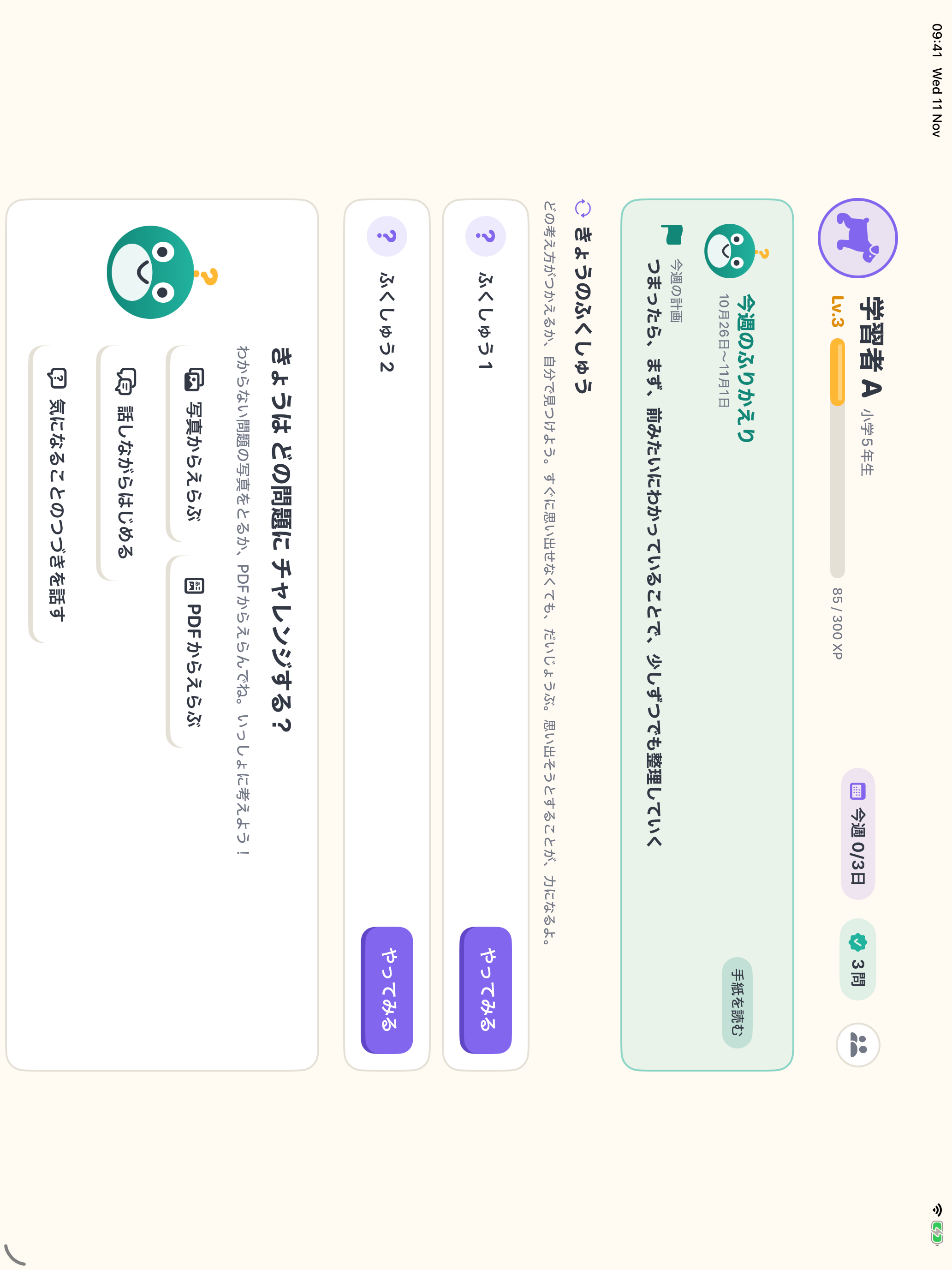
A weekly letter draws on recorded work. The child chooses or writes an “if I get stuck, then I’ll…” plan. The parent sees strategies, sticking points and help needed, with something specific to ask about. The child can see that report too.

The iPad home screen showing the weekly reflection and the child's chosen next step.

A plan the child can make their own.

The weekly letter looks back at recorded work. The child chooses or writes one response to getting stuck, and the parent gets something specific to ask about.

View the screenshot ↗

The teaching instructions also change with the subject
Mathematics
Identify the relationships, choose a representation, connect it to an expression, and check whether the answer makes sense.
Science
Ask what the child thinks will happen and why. Explain missing facts; examine a misconception against the conditions in the problem.
Reading · 国語
Summarise, question, clarify and predict. The child finds evidence in the passage; unfamiliar vocabulary is explained directly.
Social studies · 社会
Supply a fact the child does not know, then reason about causes, context and consequences, and recall the connection later.
English · 英語
Establish the meaning in Japanese, explain an unfamiliar word or grammar rule with an example, then ask the child to use it.

Grounded in research.
Open to what the evidence says.

Ten research threads shape the teaching decisions. Open a topic to see the finding, what it changes here, and where the evidence stops.

Findings from elsewhere

The literature includes classroom experiments, research syntheses, small case studies and theory. Their ages, subjects and teaching settings differ from this app’s.

Choices made here

The exact help ladder, review intervals, rewards and weekly letter are implementations informed by that work. They have not been validated together as a teaching method.

The question still open

トイ has not demonstrated improved learning in a controlled study. Testing whether a tutor follows its rules does not establish retention, transfer or better exam results.

01AI tutors: practice performance and independent learning

A high-school mathematics experiment found that an answer-giving AI could improve practice performance while harming later performance without it. A version using teaching safeguards largely mitigated that harm. This motivates a separate check of independent work. Bastani et al., 2025 · PNAS.

A university physics trial reported gains with a purpose-built tutor. Its authors also found that prompts alone did not reliably maintain the teaching sequence, so they structured it in the platform. This informed the decision to keep parts of トイ’s teaching logic in code. Kestin et al., 2025 · Scientific Reports.

Both tested specific systems in specific settings. Neither establishes an effect for this app or for younger children studying at home.

02Tutoring dialogue: generation, guidance and when to tell

The ICAP framework distinguishes receiving or manipulating information from generating an explanation and building on another person’s reasoning. It informs the request for a reason, a prediction or a drawing, rather than a succession of yes/no answers. Chi & Wylie, 2014 · Educational Psychologist.

A meta-analysis distinguished unassisted discovery from discovery supported by feedback, examples and scaffolding. The distinction matters here: the tutor can explain a missing step and then hand the work back. Alfieri et al., 2011 · Journal of Educational Psychology.

These support guided learning in broad terms. They do not validate this six-level ladder, its thresholds, or an LLM’s ability to diagnose frustration.

03Learning science: retrieval, spacing and choosing the method

In two experiments with 11–12-year-olds, mathematics practice spaced across weeks produced better month-later test performance and more accurate confidence judgments than practice in one session. Emeny, Hartwig & Rohrer, 2021 · Applied Cognitive Psychology.

A classroom trial in seventh-grade mathematics supported interleaved practice, in which successive problems require different strategies. This motivates reviews that make recognising the method part of the task. Rohrer et al., 2020 · Journal of Educational Psychology.

The app schedules due strategies and hides their names; it does not enforce an alternating sequence of problem types. Fresh variants, reduced help and FSRS scheduling are its adaptation. An optimal interval or daily dose for these whole-problem reviews has not been established.

04Mathematics, science and the Japanese teaching context

The IES mathematics guide recommends teaching visual representations, monitoring the solving process and making mathematical concepts explicit. It also cautions that multiple strategies need careful introduction and comparison. These inform the path from the situation to a diagram to an expression. Woodward et al., 2012 · IES practice guide.

Japanese research on 教訓帰納 examines extracting an accurate, transferable lesson from an error. In one junior-high study, lesson quality predicted later performance on some of the items studied. That informs the strategy card’s focus on a specific method or check. Shiba, 2023 · Japanese Journal of Educational Psychology.

A review of science education research found that texts which explicitly address a misconception can support conceptual change better than ordinary exposition. トイ’s science instructions ask the tutor to elicit a prediction, explain why a mistaken idea fails, and give the accepted account. Tippett, 2010 · International Journal of Science and Mathematics Education.

The Japanese finding is correlational; the science review concerns texts, not AI dialogue. A reflection or one corrected answer does not establish lasting conceptual change.

05Motivation: autonomy, useful feedback and rewards

Self-determination theory connects motivation with autonomy, competence and relatedness. Its educational review distinguishes supportive structure from pressure and control. It informs the child’s choices, specific feedback and the ability to ask for help or stop. Ryan & Deci, 2020 · Contemporary Educational Psychology.

トイ rewards ways of working, keeps hints free, avoids competitive rankings, and lets study days accumulate without a broken streak. A parent sees what the child tried and where help was needed.

Those are design choices. The research does not establish that this XP system improves intrinsic motivation or learning; returning to an app and learning from it are separate outcomes.

06Reading and social studies: different kinds of knowledge

Reciprocal teaching organises reading dialogue around summarising, questioning, clarifying and predicting, with adult modelling and guidance. These moves inform トイ’s reading sessions. Palincsar & Brown, 1984 · Cognition and Instruction.

The broader evidence review by Dunlosky and colleagues rates practice testing and distributed practice highly. For social studies, the app supplies missing facts, asks about their connections, and later prompts recall. Dunlosky et al., 2013 · Psychological Science in the Public Interest.

The source settings differ from a Japanese child reading with an AI. The subject-specific prompts are adaptations, not a tested transfer of the original interventions.

07Visual explanations: predict, advance, compare

In experiments on understanding a mechanical system, asking learners to predict motion from a static diagram helped comprehension; showing animation alone did not outperform static diagrams. This informed the prediction before each moving step. Hegarty, Kriz & Cate, 2003 · Cognition and Instruction.

Experiments with narrated animation also found transfer benefits from letting learners advance through segments. トイ applies that idea to short steps in a moving figure. Mayer & Chandler, 2001 · Journal of Educational Psychology.

These did not test this app’s diagrams or its learners. The drawing still needs to be accurate and appropriate to the problem.

08Curiosity: answer the child’s own question

Studies of preschool conversations found that children often pursued follow-up questions after an explanation and repeated their original question after a non-explanation. That supports treating a spontaneous “why?” as a request for information. Frazier, Gelman & Wellman, 2009 · Child Development.

In トイ, curiosity has its own mode: explain plainly, follow the child’s interest, and close with what they found out. Homework questions still use the guided problem-solving path.

The cited work concerns preschoolers and human adults. It motivates this design choice without establishing effects for AI conversations with older children.

09Weekly reflection: a specific next move

A small randomised study taught fifth-graders to contrast a desired outcome with obstacles and form if–then plans. It reported benefits for school outcomes. This is one influence on letting the child choose a concrete response to getting stuck. Duckworth et al., 2013 · Social Psychological and Personality Science.

The weekly letter draws on recorded work and the child’s strategy cards. A chosen plan can be brought back once when they next get stuck. The parent gets a concrete conversation starter.

The study tested mental contrasting together with planning, not an automated weekly letter or an if–then sentence alone. The app’s weekly format remains a design hypothesis.

10Test corrections: understand the cause of an error

A field experiment with seventh- and eighth-graders learning fractions compared reflecting on the reasoning behind their own errors with reflecting on the corresponding correct solutions. The former group showed greater procedural knowledge, with a conceptual advantage at follow-up. Heemsoth & Heinze, 2016 · Journal of Experimental Education.

トイ’s correction flow records the child’s answer, the key and their confidence, then works towards a specific error pattern and a check for next time.

This evidence concerns a particular mathematics intervention. The full correction workflow across subjects, and the choice of support from a confidence rating, have not been validated here.

THE QUESTION TO KEEP TESTING

Can the child recognise and solve a fresh problem later, with less help, and explain why the method fits?

Multiagent preparation.
One conversation.

Independent agents read and solve the problem. Once the reading is settled, they draft teaching approaches that are combined into a plan.

When readings disagree, a referee checks them against the source. An unresolved reading is marked for a parent. The conversation can proceed from the checked reading while the teaching plans are prepared.

Code keeps the session state, calculates help levels, checks replies and schedules reviews. Teaching prompts guide the diagnosis, questions and explanations. A flagged reply gets one rewrite; a second reply may still break a rule. Even when agents agree, a reading or solution can be wrong.

SwiftUI iPad app / Python + FastAPI / SQLite / FSRS review scheduling

Built around our homework table

I built this while my kids were preparing for exams. They were turning to an AI assistant for solutions; I wanted to give them somewhere to work through the part they didn’t understand.

It started with math and grew from there. The project now brings together research on tutoring dialogue, memory, drawing, motivation and reflection. Watching my kids use it keeps raising the next design question.

Curious about the project?

I shared the project on Hacker News. The conversation continues there.

Discuss on Hacker News ↗

Enlarged iPad app screenshot