
And when the question is their own
Homework gets questions. Curiosity gets an answer: a “why?” that no worksheet asked is explained straight away, and the child keeps asking for as long as they like.
An iPad tutor I built for my kids
トイ (Toi, “a question”) is a homework tutor that doesn’t hand over the solution. A child photographs the problem they are stuck on and works it out in conversation. A few days later the same idea comes back as a fresh problem, with less help.
Used at home most days since September 2026 · iPad · in Japanese
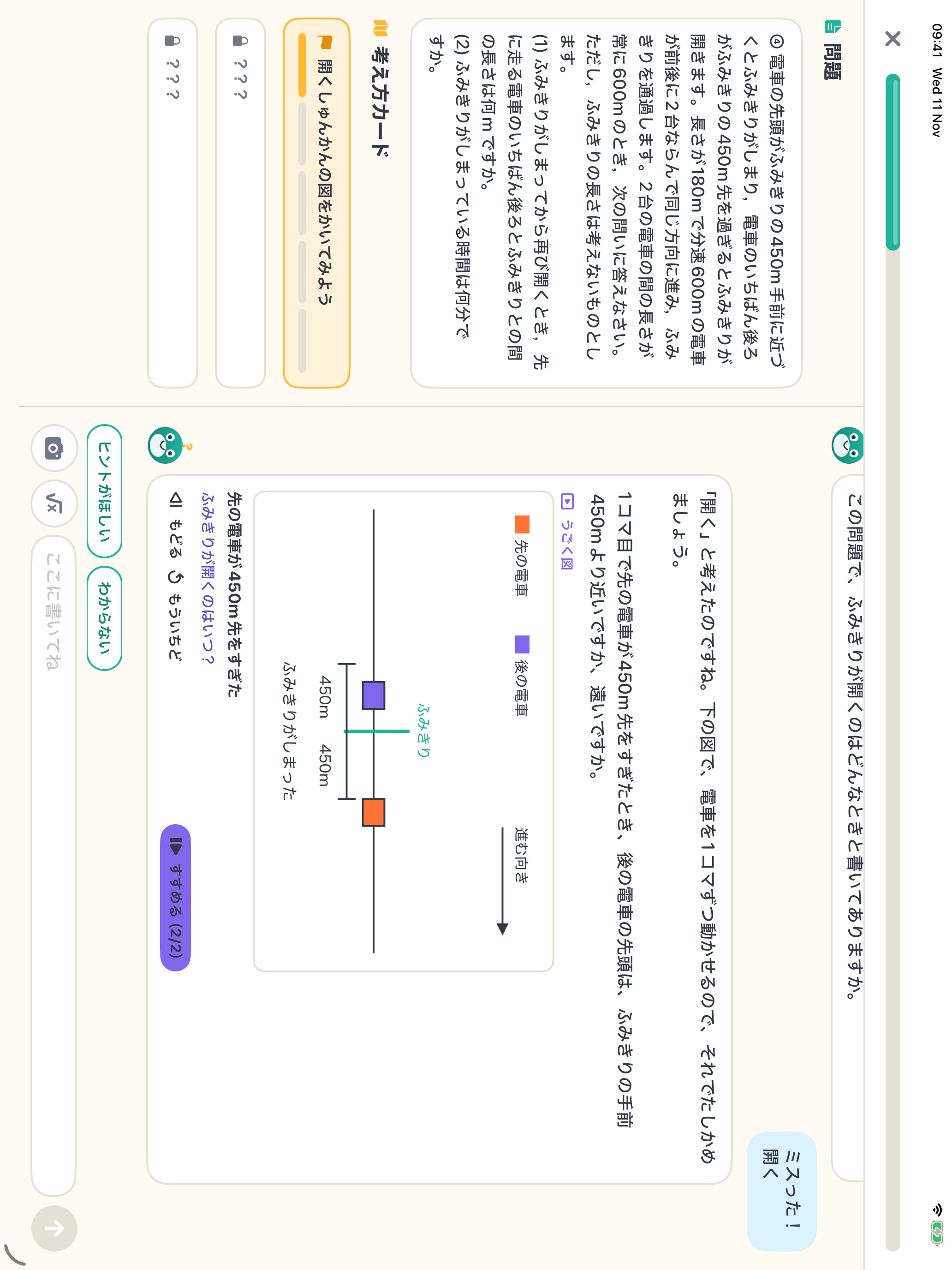
Photograph the problemWork it out in conversationMeet the idea again, days later
From our homework table
Each starts with the problem the child brought. The messages are translated from the Japanese records, with names removed and omissions marked.
Between 2 a.m. and 9 p.m., the two hands of a clock overlap again and again. Counting from 2 a.m., at what time do they overlap for the ninth time?
The child’s first guess was “around noon”. A few turns later they have settled on the eleven-o’clock hour, one hour out.
The child went on to work out the exact minute. Asked what to remember for next time, they wrote:
A second question did not help, so the tutor explained one step, with one example, and gave the rest back. The child found the hour, then the minute, and then said what they would do next time.
That last sentence is saved. It decides which problem comes back later.
01
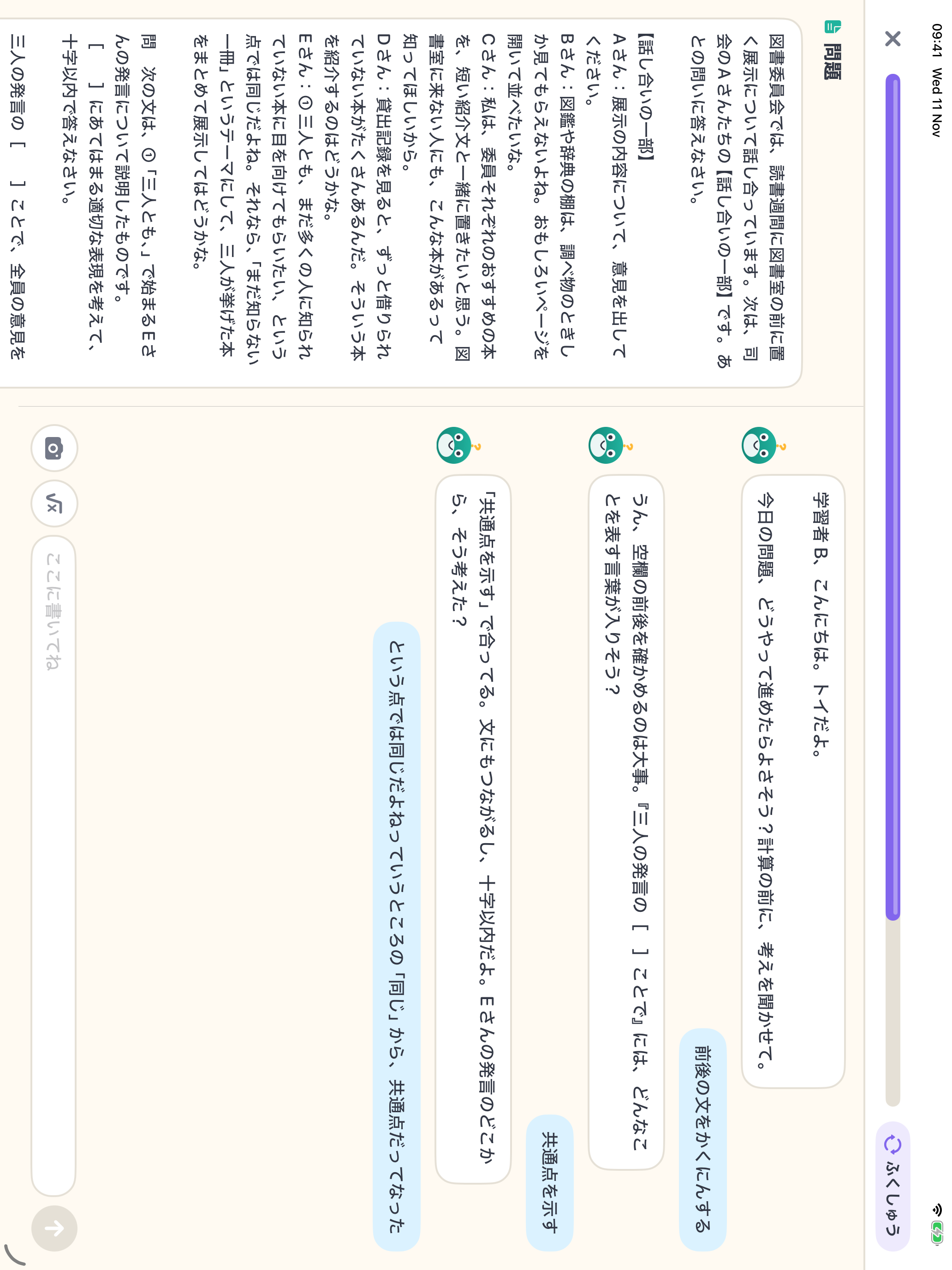
Four students are planning a wall newspaper. After several suggestions, B says: “Everyone’s ideas are the same in that respect: we want to write about the committees that supported the sports day.” The question: B’s remark produces an idea everyone can accept by [ ] each other’s ideas. Fill the blank in ten characters or fewer.
The child understood the passage and lacked the word. The tutor pointed at a phrase; the child supplied the term.
02
The saved lesson says where to look. It would be no use if it only fitted this passage.
03
A library committee is planning a display. B wants to show surprising pages from reference books. C wants each member’s recommendation. D wants books nobody has borrowed in years. E says: “All three of you are the same in that respect: you want people to notice books they don’t know yet.” The question: E proposes a theme that uses everyone’s opinion by [ ] the three remarks. Ten characters or fewer.
No hint this time. The child answered and named the clue that led there.
This is a close relative of the first problem, with the same cue word. It shows the idea was still there ten days later; it does not show that it would carry over to a very different text.
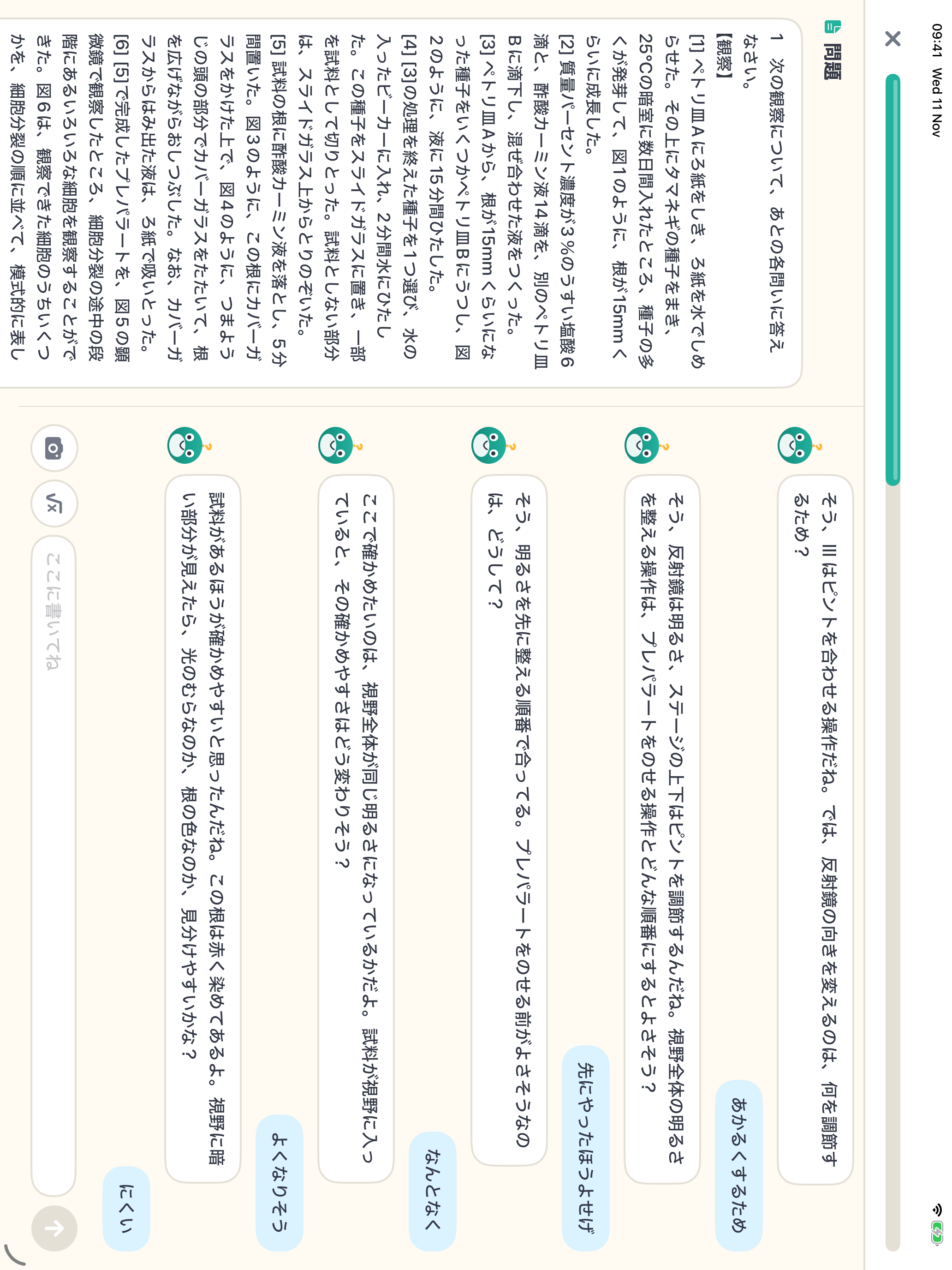
Onion root tips are stained red and looked at under a microscope. One question asks for the right order of steps: when do you adjust the brightness, and when do you put the slide on the stage?
The child chose correctly: brightness first. Asked why, they said it was just a feeling.
A few turns later
The answer was right and the reasoning behind it was wrong. An answer key stops at the tick. One question about the actual experiment brought the mistaken belief out, and the child corrected it.
Homework gets questions. Curiosity gets an answer: a “why?” that no worksheet asked is explained straight away, and the child keeps asking for as long as they like.
The tutor had promised an animation and attached none. Moving diagrams are now drawn by code, not promised by a model. The records show the failures as well, and I read them.
How it works
A photo, a PDF page or a typed question starts the session. トイ asks one short question at a time. Help grows only as it is needed: a hint, a sharper hint, one step explained, a worked example of a different problem. The answer to the homework is not on that list.
At the end the child says what to notice and what to do next time. That sentence becomes a card they keep, like “first work out which hour it lands in.”
Days later トイ sets a fresh problem that needs the same idea, without naming it. How much help the child needed decides when it returns next.
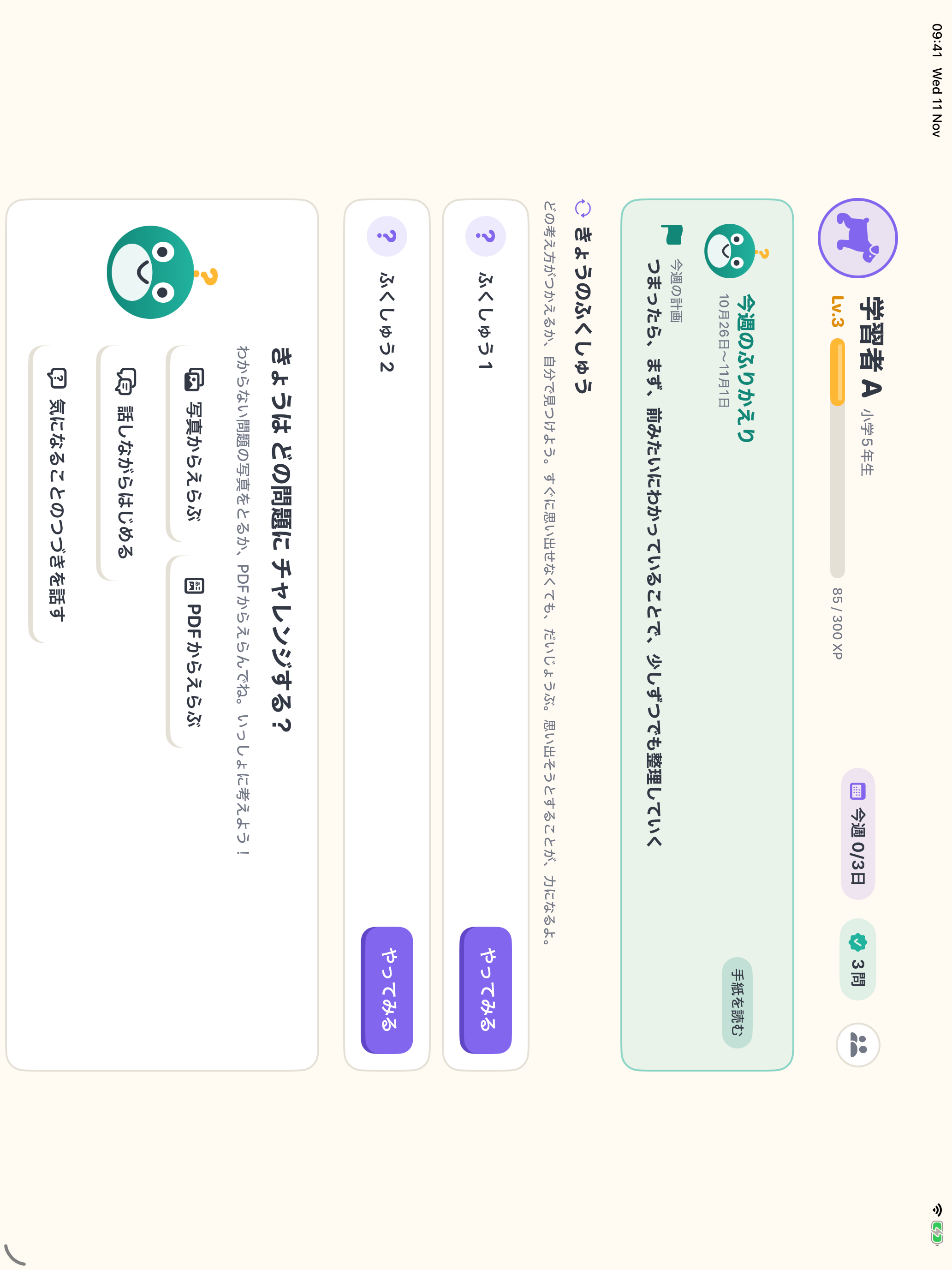
For the parent
Every week the child gets a short letter about what they worked on and picks one thing to try when they next get stuck. The parent sees where they got stuck and how much help it took. The child sees the same report.
View the screenshot ↗
The research behind it
Each rule in the tutor traces to a finding. Open one to see the study and what it changed here.
In a high-school maths experiment, students with an answer-giving AI did better in practice and worse on the later test without it. A version with teaching safeguards largely avoided the harm. Bastani et al., 2025 · PNAS. A university physics trial found gains with a purpose-built tutor, and found that prompts alone did not hold the teaching sequence. Kestin et al., 2025 · Scientific Reports.
Here: the answer is withheld, the amount of help is decided by code and not left to the model, and what counts is the later problem solved alone.
Learners who generate an explanation or a prediction engage more deeply than those who follow one. Chi & Wylie, 2014 · Educational Psychologist. Discovery with feedback, examples and scaffolding beats discovery left alone. Alfieri et al., 2011 · Journal of Educational Psychology.
Here: the child retells the problem and tries a step first. After three failed tries at one step, the tutor explains it or shows a parallel example, then hands the work back.
Maths practice spaced across weeks gave 11- and 12-year-olds better results a month later than the same practice in one sitting. Emeny, Hartwig & Rohrer, 2021 · Applied Cognitive Psychology. Mixing problem types makes choosing the method part of the work. Rohrer et al., 2020 · Journal of Educational Psychology.
Here: reviews are fresh problems with the strategy’s name hidden, scheduled with FSRS. Whether that schedule suits whole problems, as opposed to flashcards, is an open question.
Students who reflected on the reasoning behind their own errors learned more than those who studied the correct solutions. Heemsoth & Heinze, 2016 · Journal of Experimental Education. Japanese work on 教訓帰納, drawing a lesson from a solved problem, found that the quality of the lesson predicted later performance on some items. Shiba, 2023 · Japanese Journal of Educational Psychology.
Here: every session ends with the child’s own lesson, and a test-correction mode starts from what they wrote, what the key says and how sure they were.
Asking learners to predict motion from a still diagram helped understanding; animation alone did not beat still diagrams. Hegarty, Kriz & Cate, 2003 · Cognition and Instruction. Letting learners advance an animation step by step helped transfer. Mayer & Chandler, 2001 · Journal of Educational Psychology.
Here: moving diagrams stop before each step and ask what will happen, with advance, replay and back controls.
Self-determination theory ties motivation to autonomy, competence and feeling supported, and separates helpful structure from pressure. Ryan & Deci, 2020 · Contemporary Educational Psychology. Children keep asking after a real explanation and repeat the question after a non-answer. Frazier, Gelman & Wellman, 2009 · Child Development.
Here: hints cost nothing, there are no rankings and no streak to break, points reward trying and explaining, and a child’s own “why?” gets a straight answer.
Also behind the design: the IES guide to teaching problem solving, reciprocal teaching for reading, refutation texts for science misconceptions, the Dunlosky review of study techniques, and if–then planning for the weekly letter.
These studies tested other tools, with other children, in other settings. トイ has not been through a controlled study. What I can show is the conversations, and the one question I keep testing: can the child solve a fresh problem later, with less help, and say why the method fits?
Under the hood
Two AI models from different labs, Claude and GPT, each read the photo and solve the problem on their own. If their readings differ, a referee checks them against the photo; if that fails, the problem is put aside for a parent. Their two teaching plans are merged into one.
The teaching rules live in code, not in the prompt: the server keeps the session state, counts failed attempts, sets the level of help, checks every reply against the rules and schedules the reviews. A reply that breaks a rule is rewritten once. It still makes mistakes: two models can agree on a wrong reading.
SwiftUI iPad app / Python + FastAPI / SQLite / FSRS review scheduling / runs on a box at home
A family project
My kids were preparing for exams and had found out that an AI assistant will solve anything you photograph. The homework got done. The understanding did not.
So I built the opposite: something that keeps them company in the part they don’t understand and won’t do it for them. It began with maths and is now used for science, Japanese and social studies too. I read the sessions, and what I see in them changes the next version.
Talk to me
I would like to hear from parents, teachers and anyone building tutors. The conversation is on Hacker News.